
Seal and insulate at once
Spray Foam Insulation in Appleton, WI
Closed cell where moisture and concrete are involved, open cell where it saves money safely.
- Free on-site estimates
- Every area quoted in writing with its R-value
- Wiring, moisture and venting checked before we insulate
What Spray Foam Does Differently
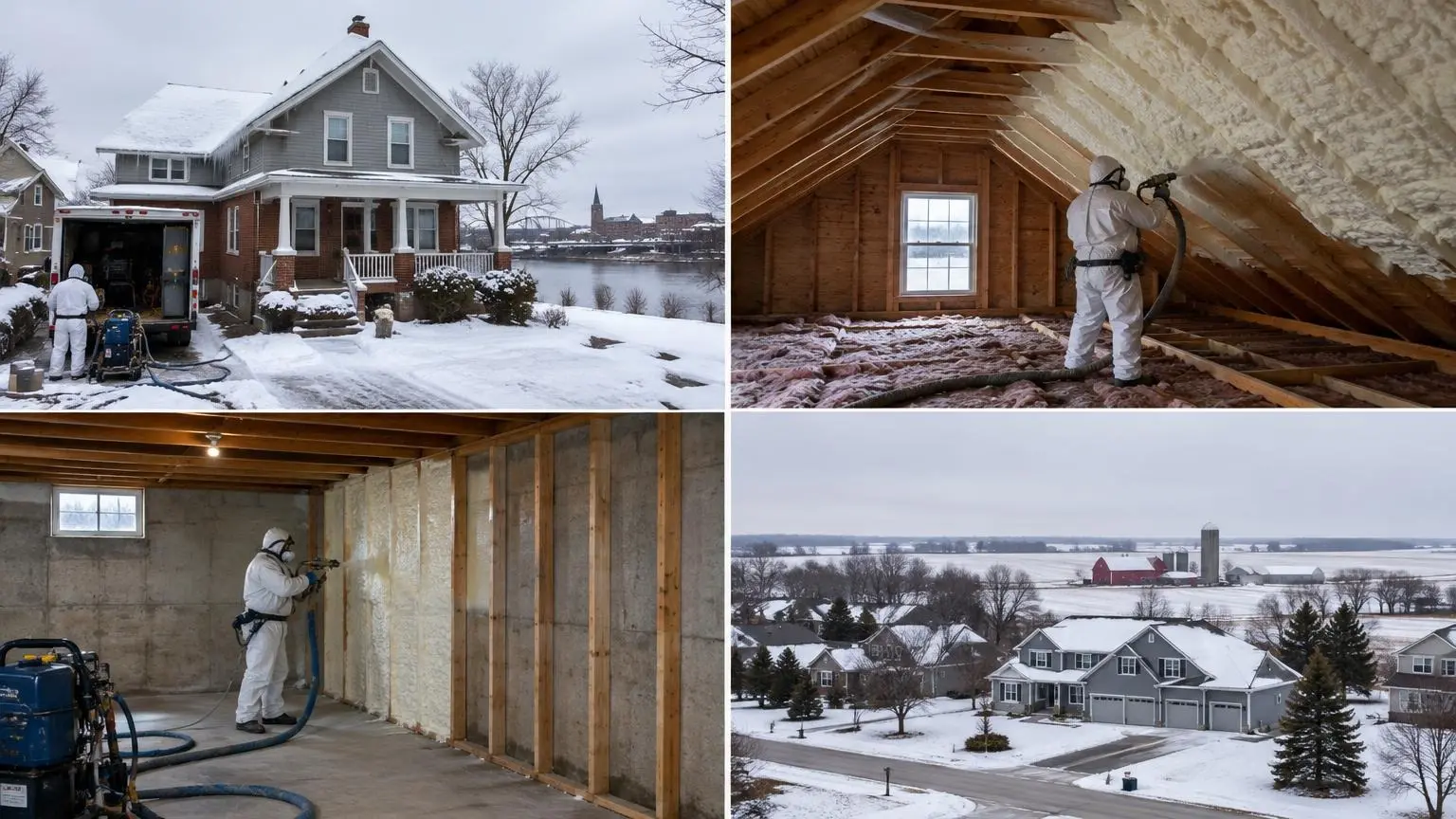
Spray foam insulation is mixed at the gun and expands as it hits the surface, filling the cracks, gaps and odd shapes that batts and loose fill cannot seal. Because it sticks to wood, concrete and steel, it stops air movement as well as slowing heat. In a Fox Valley winter, that air sealing is often worth more than the R-value alone.
Two kinds of foam
Closed-cell foam is dense and hard once cured. HomeGuide lists it at R-5 to R-7 per inch. At typical thickness it acts as a vapor retarder, it does not hold water, and it adds stiffness to what it is sprayed on. We use it against concrete, on rim joists, in crawl spaces and on the steel of pole buildings. Open-cell foam is spongy and expands many times over. At R-3.5 to R-3.7 per inch it takes more thickness to reach the same R-value, but it costs less per square foot, fills irregular cavities and absorbs sound. It suits interior walls, roof lines with a moisture plan and spaces where vapor needs to pass.
When foam is the right call
Foam makes the most sense where space is tight or air leaks are concentrated: rim joists, cathedral ceilings with shallow rafters, kneewalls, floors over garages, walls in additions and new construction, and outbuildings. Across a wide open attic floor, sealing the leaks and blowing loose fill usually gives more R-value for the money, and we will tell you that.
Before we spray
We check for wiring that should be updated, wet framing, roof or plumbing leaks and anything that gets hot, like flues and recessed lights. Foam stays clear of heat sources, and exposed foam in living spaces usually needs a fire-rated covering. We note all of that on the quote.
Common Foam Applications
Where foam goes most often, and which kind.
Rim joists
Closed cell across the band and sill, sealing joist ends and every penetration.
Foundation and crawl space walls
Closed cell on concrete or block to insulate and keep humid air off cold surfaces.
Cathedral ceilings
Foam between rafters where loose fill cannot be used, with a vapor plan.
Kneewalls and bonus room floors
Foam to stop the drafts in rooms over garages and under roof slopes.
Open walls
Foam in stud bays during remodels, additions and new builds.
Steel and wood outbuildings
Closed cell on panels and framing to stop condensation.
Published Spray Foam Insulation Costs
| Job | Range and source |
|---|---|
| Spray foam, installed | $1.50 to $5.00 per sq ft (HomeGuide) |
| Open-cell / closed-cell | $1.50 to $3.50 / $3.00 to $5.00 per sq ft (HomeGuide) |
| About 1,000 sq ft | $1,500 to $5,000 (HomeGuide); $3,150 to $7,500 existing home (Fixr) |
| Existing walls / new construction | $3.15 to $7.50 / $2.75 to $6.50 per sq ft (Fixr) |
| All exterior walls | $4,000 to $10,000 (HomeGuide) |
| Whole house | $8,000 to $20,000 (HomeGuide); $10,000 to $30,000 (Fixr) |
| Typical job minimum | $1,000 to $2,000+ (HomeGuide) |
Ranges come from HomeGuide (2026) and Fixr (2025) and are national, not local. Foam type, thickness, access and prep change the total, and small jobs often hit a minimum. Once we have measured, the figure on your written estimate is what you pay.
Our Foam Process
1. Site visit
We measure, check for moisture, wiring and heat sources, and talk through goals.
2. Written quote
Each area with foam type, thickness, R-value and any prep or covering.
3. Protect and ventilate
Floors and belongings covered, masking done and ventilation set up.
4. Spray in passes
Foam applied at the thickness each pass allows for a proper cure.
5. Cure, clean, hand back
We clean up and tell you when the space is ready.
Why Choose Us for Spray Foam Insulation
Surface by surface
Closed or open cell chosen for each area, with the reason on the quote.
No foam where it doesn't pay
If loose fill is the better buy, we say so.
Cure time explained
You know before we start how long to stay out.
Spray Foam Insulation Questions
How long does spray foam take to cure?
HomeGuide advises staying out of the sprayed area for at least 24 hours. In many basement jobs you can stay in the rest of the house if the area is sealed off and ventilated; we explain the plan for your house.
Does spray foam need a vapor barrier in Wisconsin?
Closed-cell foam at typical thickness acts as a vapor retarder itself. Open-cell foam does not, so it needs a moisture plan where it is used. We explain which applies on your quote.
Can spray foam go over old insulation?
Foam needs a clean, dry surface to bond, so old batts usually come out of the area first. Loose fill in an attic can often stay if we are blowing more on top.
Will spray foam fix a leaky foundation?
No. Foam is not a waterproofing repair. Leaks are addressed first; then foam insulates and seals the dry wall.
Spray Foam Insulation Service Areas
- Spray Foam Insulation in Appleton, WI
- Spray Foam Insulation in Grand Chute, WI
- Spray Foam Insulation in Fox Crossing, WI
- Spray Foam Insulation in Menasha, WI
- Spray Foam Insulation in Little Chute, WI
- Spray Foam Insulation in Kimberly, WI
- Spray Foam Insulation in Combined Locks, WI
- Spray Foam Insulation in Kaukauna, WI
- Spray Foam Insulation in Harrison, WI
- Spray Foam Insulation in Sherwood, WI
- Spray Foam Insulation in Greenville, WI
- Spray Foam Insulation in Hortonville, WI
- Spray Foam Insulation in Freedom, WI
- Spray Foam Insulation in Buchanan, WI
- Spray Foam Insulation in Black Creek, WI
Get a Spray Foam Insulation Estimate
Tell us where the house feels cold and we will tell you where foam makes sense.